
 PithiPhone · 2026
A private place to think out loud before the thought disappears.
Pith is an iPhone app that turns raw voice into structured insight entirely on the device. A personal journal, a meeting or a private conversation never goes to the cloud.
Why it exists
Most thinking tools ask people to get organised before they are allowed to be honest.
Voice notes are fast, intimate and almost frictionless, but they turn into an unsearchable pile of audio. Cloud transcription solves retrieval and asks people to trade away context that may be deeply personal.
Pith reframes the problem: record without performing, then get back a useful shape. It had to feel as private as a journal while being more helpful than a transcript.
The landscape
Retrospective analysisWritten in November 2026 from the shipped work and the project record, not from original project notes.
Voice tools make you choose: structure in the cloud, or privacy with a raw transcript.
Cloud notetakers like Otter and Granola turn speech into summaries, but the audio or transcript is processed on their servers. Apple's own apps transcribe on the iPhone and mostly stop at a transcript.
Pith aims for the corner they leave empty: structure as good as a cloud notetaker's, without anything leaving the phone.
What you get back

Where it's processed
- This project
- Direct competitor
- Point at a product for what it doesTap a product for what it does
| Product | Processed on the device | Structured output | Keeps your audio | Works offline | Price | Where it falls short |
|---|---|---|---|---|---|---|
| Otter | Pro $16.99/mo | Everything goes through Otter's cloud, and its terms let it use content to improve the service. | ||||
| Granola | Business $14/user/mo | Cloud processing, and no audio to go back to. | ||||
| Apple Notes | Free | Summaries only on Apple Intelligence iPhones, and some requests go to Apple's servers. | ||||
| Voice Memos | Free | A transcript is where it stops: no summary, chapters or questions. | ||||
| Pith | – | Needs a recent iPhone that can run Apple's on-device models. |
Principles
I used the tensions in voice notes to decide what Pith should and shouldn't do.
- 01Voice, not a formThoughts arrive before structure. Pith takes one before asking anyone to sort it.
- 02Privacy you can feelAirplane mode makes the boundary obvious, without a settings page.
- 03Recall in contextReturn to a thought by asking, not by replaying every note.
Three modes
The same record button can mean very different things.
Journal is for a walk or a late-night thought. Briefing is for meetings, lectures and consultations where recall matters. Conversation tells voices apart in a shared discussion.
Ask Pith
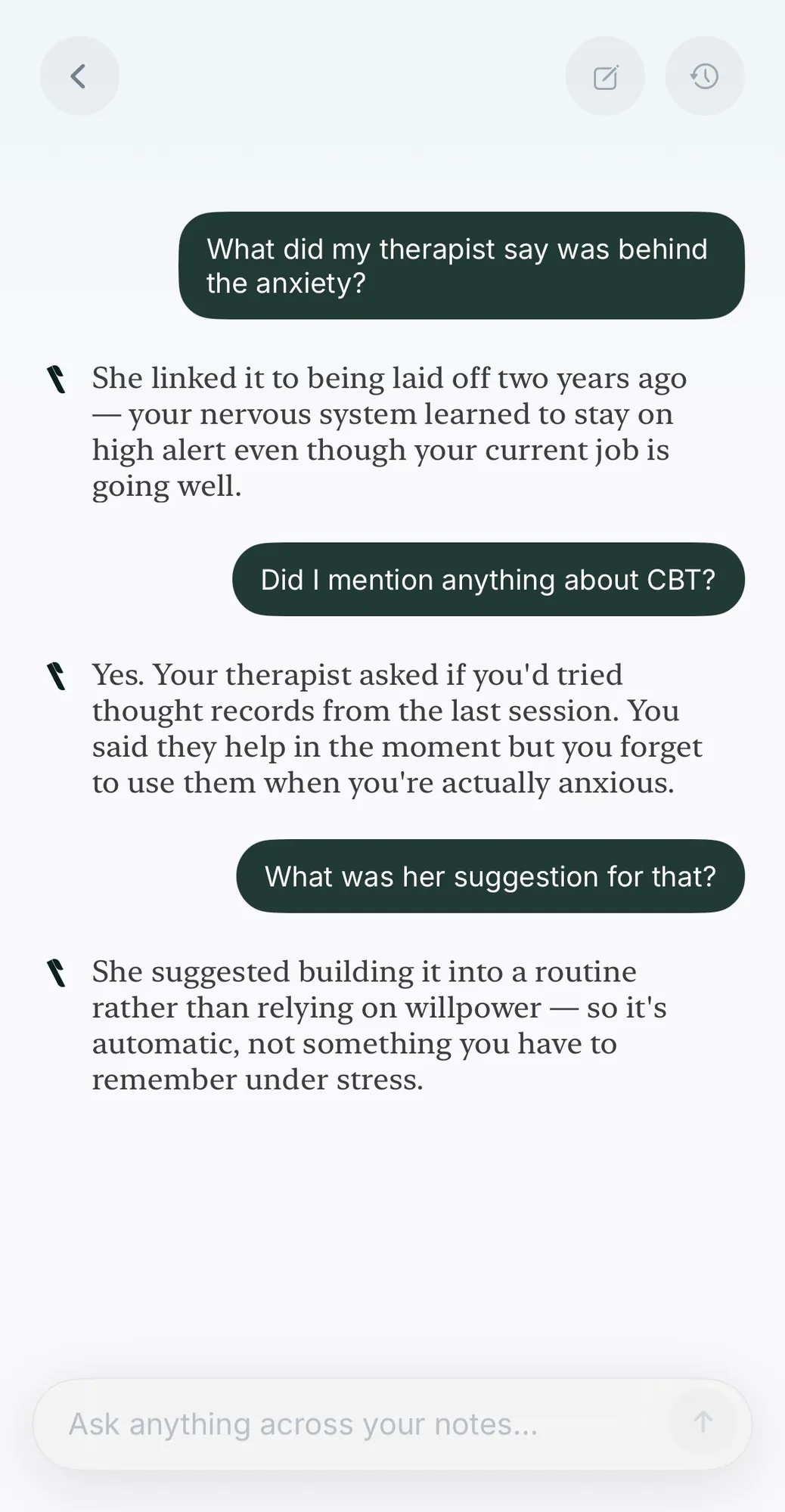
After every session, the notes become a private AI you can talk to.
Ask follow-up questions, go deeper on a topic or explore what you didn't get to say. Pith already knows the full context of the session, and never sends that context anywhere.
- 01RecordAny mode, even offline
- 02StructureSummary, chapters or a map
- 03AskFollow-ups with the full context
- 04On deviceNothing leaves the iPhone
Asking a note a question, offline.
Designed around trust
A sentence that became a product test.
“True clarity should not cost you your privacy.”
If a state, an interaction or a piece of language made the experience feel like surveillance, it didn't belong in Pith. Privacy had to be part of the rhythm of the product, not a policy appended to it.
On your iPhone
- Your audio
- Transcripts and summaries
- Ask Pith conversations
Never
- Cloud uploads
- Another account to manage
- Needing a connection
My role
Product design and development, without losing the point of view between them.
- 01Experience framingWhat Pith should and shouldn't do
- 02Interaction flowsRecording to recall, connected
- 03Visual systemCalm, private, legible
- 04Native productCarried into the iPhone app
Tradeoffs
On-device was the promise. It was also the constraint.
Looking back
Retrospective analysisWritten in November 2026 from the shipped work and the project record, not from original project notes.
Reach is the next design problem.
Making privacy tangible, through airplane mode instead of a policy page, is the decision that holds the product together. The hardware requirement is its cost. The next version worth exploring is a lighter path for older phones, such as a private transcript-only mode, so more people can keep their thoughts to themselves.
For context, the same line is drawn across the platform: Apple's own on-device models, Apple Intelligence, also start at iPhone 15 Pro.
- Earlier iPhonesNot supported
- iPhone 15 ProPith's minimumAlso Apple Intelligence's first iPhone
- iPhone 16 and laterSupported